Overview
About the Punjab Board Economics Book
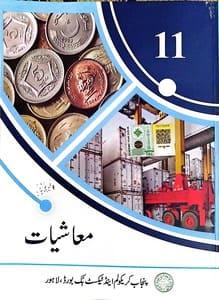
The Class 11 Economics (معاشیات) book introduces students to core microeconomics and macroeconomics concepts including nature and scope of economics, consumer behavior analysis, basic mathematical/statistical tools in economics, demand, supply, market equilibrium, theory of production of wealth, scale of production, laws of return, cost of production, analysis of revenue, markets, and factor pricing.
The book is written in Urdu medium and is suitable for classroom learning, self-study, tuition preparation, and board exam revision. Students who search for PECTAA Economics Book, PCTB Economics Book, PTB Economics Book, Punjab Textbook Board book, or Punjab Curriculum and Textbook Board Economics PDF are usually looking for this type of textbook.
Punjab Board / PECTAA Curriculum Relevance
Punjab Board books are now commonly associated with PECTAA curriculum reforms, while many students still search using older terms such as PCTB, PTB, and Punjab Textbook Board. For this reason, this page uses both new and old educational terms naturally to help students find the correct Economics textbook PDF.
This latest Punjab Board book supports conceptual learning and helps students prepare according to the current syllabus. It is also useful for students who want to revise from the official-style textbook before solving exercises, short questions, long questions, and MCQs.
Helpful for Board Exams and Economic Sciences Foundation
Economics is a key subject for FA and Commerce students. The concepts covered in this book are helpful not only for annual board exams but also for building the conceptual base required for future degrees in finance, economics, business administration, and commerce.
Students should read each chapter carefully, understand microeconomic behaviors, graph derivations, and mathematical formulations, and practice exercise questions. The book also helps students improve economic vocabulary.
Who should use this book
This Economics textbook is useful for:
- 11th class Punjab Board students
- Class 11 / HSSC Part 1 FA humanities and commerce students
- Urdu medium students
- Teachers preparing classroom economics lessons
- Self-study students looking for conceptual clarity
- Tuition academies
- Students revising for economics board exams
- Learners preparing microeconomics and macroeconomics concepts
Chapters Included in 11th Class Economics Book Punjab Board
The following chapters are included in the Punjab Board / PCTB Class 11 Economics Urdu medium textbook for the 2026-2027 session:
1معیشت کی نوعیت اور وسعت (Nature and Scope of Economics)
2رویہ کا تجزیہ (Analysis of Consumer Behavior)
3معیشت میں شماریات اور ریاضی کے بنیادی آلات (Basic Mathematical and Statistical Tools in Economics)
4طلب (Demand)
5رسد (Supply)
6منڈی کا توازن (Market Equilibrium)
7نظریہ پیدائش دولت (Theory of Production of Wealth)
8پیمانہ پیدائش اور قوانین حاصل (Scale of Production and Laws of Return)
9مصارف پیدائش (Cost of Production)
10وصولی کا تجزیہ (Analysis of Revenue)
11منڈی (Market)
12تقسیم، عوامل پیدائش کے معاوضوں کا تعین (Distribution, Determination of Factors of Production Rewards)
* Chapter numbers follow the standard Punjab Board Class 11 Economics curriculum for Intermediate FA/Commerce students.
How to Use This Book
Accessing the Punjab Board Class 11 Economics book on this page is quick and simple:
- View Online — Use the embedded PDF viewer above to read any chapter directly in your browser. No download is needed.
- Download PDF — Click the Download PDF button in the bar above the viewer to save the complete book on your device for offline study.
- Share Freely — Share this page with classmates, students, or teachers who need the book. It is always free and accessible.
This resource is provided for free educational use only. It is not intended for commercial reproduction, resale, or redistribution.
Disclaimer: This website does not write, publish, sell, or own the Class 11 Economics textbook. The book is an official publication of the Punjab Curriculum and Textbook Board (PCTB), shared here strictly for free educational and reference use by students and teachers. All intellectual property rights belong to PCTB and the Government of Punjab, Pakistan.