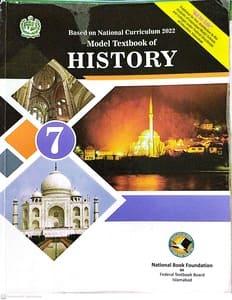
Access complete chapter-wise solved notes, historical source analyses, conceptual MCQs, and solved exercise questions updated for the 2026-2027 National Book Foundation (NBF) syllabus and Single National Curriculum (SNC) guidelines.
Federal BoardClass 7HistoryEnglish MediumSession 2026-2027SLO BasedSNC AlignedNBF TextbookChapter-Wise Notes
Quick Answer
This page provides comprehensive solved notes for Class 7 History under the Federal Board (FBISE) curriculum. It includes SLO-based conceptual MCQs, step-by-step solved exercises, short-answer questions, detailed long-answer questions, and historical timelines. You can read these notes online or download the free PDF notes for chapters 1 to 6 offline.
Chapter-Wise History Notes
Select any chapter to read online or download the PDF notes for exam preparation.
Chapter 1
Middle Ages in Europe
Explore the decline of the Roman Empire, the rise of Feudalism and its effects, the Roman Catholic Church, the Byzantine Empire, the Justinian Code, the Dark Ages, and the Mongol invasions of Europe.
Study the Umayyad and Abbasid Dynasties, conquests in Sindh by Muhammad Bin Qasim, expansions in Spain and Africa, achievements in science, art, architecture, and the causes of their decline.
Analyze the Seljuk, Ayyubid, Fatimid, Safavid, and Ottoman Empires. Study the causes, events, and effects of the Crusades, the role of Sultan Salahuddin Ayyubi, and administrative systems.
Trace the history of the Delhi Sultanate (Ghaznavids, Ghaurids, Slave, Khilji, Tughluq, Sayyid, and Lodi Dynasties), prominent rulers, administrative reforms, and the spread and impact of Sufism.
Investigate the foundation, consolidation, and zenith of the Mughal Empire from Babur to Aurangzeb. Learn about Akbar's reforms, Mansabdari system, Mughal architecture, and reasons for decline.
Discover major epochs shaping modern civilization, including the Age of Discovery, Renaissance, Reformation, Thirty Years' War, Scientific and Industrial Revolutions, and French Revolution.
The Class 7 History Notes FBISE 2026-2027 serve as a comprehensive study companion for students preparing for their Federal Board assessments. Middle school history covers massive socio-political transitions, tracing the development of global and regional civilizations. These notes are designed to break down challenging historical periods—ranging from the Middle Ages in Europe and the golden age of Islamic empires to the Delhi Sultanate, the Mughal Empire, and the birth of the modern world—into easy-to-understand structured sections.
Following the Student Learning Outcomes (SLO) guidelines introduced by the Federal Board, exams assess conceptual clarity, critical thinking, and the analysis of historical events rather than rote memorization. Our notes align strictly with these SLO standards, offering solved textbook exercises, objective-type multiple-choice questions (MCQs), and concise short questions highlighting key administrative reforms and battles.
In addition, historical timelines and charts are integrated throughout the study material to help students organize dynastic successions and key milestones. Students can read the full course material online or download chapter-wise solved notes in PDF format, ensuring effective revision before school tests and final examinations.
What Are These History Notes?
These Class 7 History notes are designed to simplify the NBF textbook curriculum for Federal Board English medium students. They provide clear explanations, logical summaries, and precise question-answer sets that align with the requirements of FBISE examiners.
Each chapter is structured to support the official National Book Foundation (NBF) textbook. Whether you are studying feudalism in medieval Europe, the translation movements of the Abbasids, the reforms of Sher Shah Suri, or the impacts of the Industrial Revolution, these notes provide organized bullet points and headings that make self-study productive.
Using these notes helps students build confidence and structure their revision process. The notes cover the following essential components:
Chapter summaries and historical source analysis
Important terms, dates, and glossary definitions
Key concepts and detailed event explanations
Solved textbook exercises and fill-in-the-blanks
Conceptual and SLO-aligned MCQs with keys
Short-answer questions for quick concepts
Detailed long-answer questions with headings
Important comparisons between historical eras
Dynastic timeline tables and chronological charts
SLO-based practice questions for board examinations
Exam-focused revision points and quick summaries
This comprehensive structure ensures that students can thoroughly revise the entire history syllabus.
What Is Included in the Notes?
Students can use the chapter-wise material to access the following learning resources:
✓
Solved Exercises
Complete and accurate answers to all NBF textbook exercise questions for every chapter.
A
MCQs
SLO-aligned conceptual and memory-based multiple-choice questions with verified answer keys.
Q
Short Questions
Concise answers to short questions focused on definitions, rulers, events, and quick comparisons.
L
Long Questions
Detailed and structured answers for long questions, featuring appropriate headings and explanations.
D
Definitions
Precise definitions of key historical terms and concepts like feudalism, renaissance, and crusades.
◎
Timelines
Chronological tables and simplified tables detailing dynasties, reigns, and major historical milestones.
★
SLO-based Questions
Conceptual practice questions tailored to the latest FBISE analytical exam pattern.
↓
PDF Download
Free downloadable PDF files for each of the 6 chapters, perfect for offline reading.
SNC and National Curriculum Alignment
These Class 7 History notes are 100% aligned with the Single National Curriculum (SNC) and National Curriculum guidelines of Pakistan. They are structured according to the latest Student Learning Outcomes (SLO) framework prescribed by the Federal Board (FBISE) for the 2026-2027 academic session, utilizing the official National Book Foundation (NBF) textbook.
How to Prepare Class 7 History from These Notes
Follow this simple preparation method to get better results in History.
1
Read the textbook chapter first
Begin by studying the textbook chapters published by NBF to gain a broad understanding of the historical narrative and timelines.
2
Revise key concepts
Go through the definitions and summaries in these notes to reinforce what you learned from the textbook.
3
Solve MCQs
Practice the conceptual MCQs to build quick recall and evaluate your objective-section preparation.
4
Prepare short questions
Learn the short-answer questions to understand how to state historical facts and definitions concisely.
5
Prepare long questions
Study the long questions under proper headings and practice organizing your answers with structured points.
6
Analyze timelines
Review the chronological tables and dynasties to visualize historical successions and dates clearly.
7
Revise before tests and board exams
Use the chapter-wise PDF downloads for quick revisions during class tests, send-ups, and final exams.
Related Resources
Use these resources to complete your History preparation and other subjects.
Are these Class 7 History notes updated for the 2026-2027 session?
Yes, these solved notes are fully updated for the 2026-2027 academic session based on the latest National Book Foundation (NBF) textbook for FBISE.
Do these notes cover the latest SLO guidelines?
Yes, these notes follow the Student Learning Outcomes (SLO) framework introduced by the Federal Board, emphasizing conceptual understanding of historical events and analysis.
Is the complete NBF textbook syllabus covered?
Absolutely. All 6 chapters, from the Middle Ages in Europe to the Modern World, are thoroughly solved and explained.
Are solved textbook exercises included in these notes?
Yes, all textbook exercise questions, including MCQs, short questions, and long questions, are fully solved for every chapter.
Can I download these Class 7 History notes as PDF?
Yes, chapter-wise PDF download links are provided so you can download and save the notes for offline study at no cost.
Do these notes include timelines and tables?
Yes, major historical events, successions, and durations of dynasties (such as the Delhi Sultanate or Mughals) are arranged in clear timelines.
How should students prepare for long questions in History?
We recommend learning the answers by dividing them into key headings (such as causes, events, consequences, and administrative features) as structured in our notes.
Are these notes free to read online?
Yes, all study notes, textbook guides, and solved exercises on StudyPlusPlus are 100% free for all students.
Are these notes aligned with the Single National Curriculum (SNC)?
Yes, these notes and the corresponding NBF textbook strictly comply with the National Curriculum guidelines approved by the government.
Can Punjab Board students use these notes?
While these notes are tailored to the NBF textbook for FBISE, the historical topics (such as Umayyads, Abbasids, Delhi Sultanate, Mughals, and Industrial Revolution) are highly relevant for Punjab Board students as well.
What is the best way to secure high marks in FBISE Class 7 History?
To score high, focus on conceptual SLO questions, present your answers with neat headings, mention correct dates and rulers, and summarize events using chronological points.
Educational Notice: This content is provided for educational support only. It is not for sale, redistribution, or commercial use. StudyPlusPlus is not claiming official ownership of any government textbook material.