Chapter 1
Notes + Exercise Linkحمد
Comprehensive notes for Hamd including verse-by-verse Tashreeh (explanation), central idea (Markazi Khayal), solved textbook exercise questions, vocabulary meanings, and conceptual MCQs.
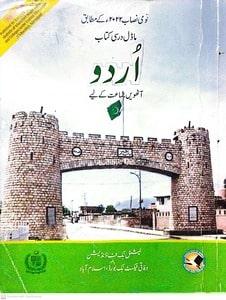
Study chapter-wise, SLO-based Class 8 Urdu notes prepared according to the latest Federal Board syllabus and NBF textbook. Access solved exercises, MCQs, short questions, long questions, Tashreeh, Khulasa, and grammar revision material.
The 8th Class Urdu Notes FBISE page provides complete chapter-wise study material for Federal Board Grade 8 students following the 2026-2027 National Book Foundation (NBF) curriculum. Students can access solved textbook exercises, conceptual MCQs, short-answer questions, detailed long questions, Ash'aar ki Tashreeh (poetry explanation), Sabaq ka Khulasa (lesson summaries), and Urdu grammar rules. All material strictly adheres to SLO-based learning and the Single National Curriculum (SNC) to help learners achieve outstanding marks in annual exams.
Select any chapter to read online or download the PDF notes for exam preparation.
Comprehensive notes for Hamd including verse-by-verse Tashreeh (explanation), central idea (Markazi Khayal), solved textbook exercise questions, vocabulary meanings, and conceptual MCQs.
Detailed notes on Naat-e-Rasool-e-Maqbool (PBUH) covering poetic explanations (Tashreeh), themes of love and devotion for the Holy Prophet, solved textbook questions, and SLO-based short answers.
In-depth study of filial duty, moral values, and respect for parents guided by the perfect prophetic model (Uswa-e-Kamil), complete with lesson summary (Khulasa) and solved exercises.
Inspiring biographical lesson on the life, humanitarian service, and philanthropy of Abdul Sattar Edhi, including comprehensive textbook question-answers and conceptual MCQs.
Biographical study commemorating Dr. Abdul Qadeer Khan's monumental scientific contributions to Pakistan's defense, complete with lesson overview, key dates, and solved exercise questions.
Patriotic chapter celebrating Pakistan's highest military honor(Nishan-e-Haider) and the selfless valor of brave martyrs, featuring detailed answers, lesson summary, and grammar points.
Engaging moral story highlighting wisdom, alertness against deceit, and critical moral discernment, accompanied by solved comprehension questions and objective assessments.
Soul-stirring national anthem and patriotic poetry notes covering stanzas explanation (Band ki Tashreeh), patriotic spirit, literary devices, and solved textbook exercises.
Exhaustive biographical chapter on Mohtarma Fatima Jinnah's relentless struggle in the Pakistan Movement, featuring detailed comprehension answers, short questions, and MCQs.
Thought-provoking lesson on the supremacy of law, civic ethics, justice, and societal discipline, with complete solved textbook questions and SLO-based analytical queries.
Humorous and satirical poem depicting the comical scenes and adventures of train travel in Pakistan, complete with verse explanation (Tashreeh) and solved exercise solutions.
Critical awareness chapter on the destructive physical, psychological, and social impacts of substance abuse, featuring essay-type answers, short notes, and solutions.
Classical Urdu Ghazal analysis explaining Matla, Maqta, Radeef, Qafia, and philosophical nuances of each Sher (couplet), with complete solved textbook exercises.
Captivating travelogue (Safar-Nama) exploring the scenic natural beauty, culture, and tourist spots of Swat Valley, accompanied by solved comprehension questions and vocabulary.
Profound philosophical exposition of Allama Iqbal's metaphor of the Shaheen(Falcon) symbolizing courage, ambition, and self - reliance(Khudi) for Muslim youth, with solved exercises.
Literary and philosophical reflection exploring the true essence of inner beauty, moral virtue, and spiritual harmony, featuring detailed explanations and question answers.
Informative overview of the exemplary, time-tested bilateral friendship between Pakistan and China, highlighting mutual cooperation, CPEC, and solved textbook exercises.
Exhilarating account of Pakistan's historic triumphs and participation in international sports including Olympics, Cricket, Hockey, and Squash, with solved exercises and MCQs.
Poetic reflection on the rich colors of twilight and nature's serene magnificence, offering stanza-by-stanza Tashreeh, Markazi Khayal, and textbook exercise solutions.
Heartwarming poem on the innocence, playful joy, and vital importance of children in shaping the future of a society, complete with poetic explanations and solved questions.
Essential educational chapter addressing climate change, pollution hazards, tree plantation, and ecological conservation, accompanied by comprehensive solutions and questions.
Uplifting concluding supplication reflecting sincere prayers for national peace, personal rectitude, and spiritual enlightenment, with full poetic Tashreeh and solved exercises.
The 8th Class Urdu Notes FBISE 2026-2027 serve as an authoritative, student-centered academic companion for Grade 8 students under the Federal Board of Intermediate and Secondary Education. Fully aligned with the Single National Curriculum (SNC) and the official National Book Foundation (NBF) textbook, these notes cover prose lessons (Asbaaq), poetry (Manzoomat / Nazmein), classical couplets (Ghazliyat), travelogues, biographies, moral tales, and foundational Urdu grammar.
With the Federal Board's transition toward Student Learning Outcomes (SLO) based examinations, the assessment pattern strongly emphasizes critical literary comprehension, thematic analysis, vocabulary enrichment, creative composition, and contextual interpretation rather than rote memorization. These notes are meticulously structured to meet FBISE grading criteria and cognitive domains across knowledge, understanding, and application.
Every chapter features structured lesson summaries (Khulasa), verse-by-verse Tashreeh with central ideas (Markazi Khayal), solved textbook exercise questions, conceptual MCQs with answer keys, concise short-answer questions, and descriptive long questions. This systematic structure empowers students to excel in monthly class assessments, terminal exams, and annual board examinations with flying colors.
These educational notes serve as an all-inclusive academic guide specifically crafted for Class 8 students studying Urdu under the Federal Board curriculum. They break down intricate literary terms, classical poetry expressions, thematic prose texts, and grammatical rules into easily digestible, high-scoring study materials.
Designed to be used alongside the prescribed National Book Foundation (NBF) textbook, these notes provide students with structured answers, thematic breakdowns, and model paper solutions to bridge classroom learning with board exam requirements.
Key elements covered across all 22 chapters of these notes:
Students can use the chapter-wise material to access the following learning resources:
Complete step-by-step solutions to textbook exercise questions, comprehension items, and grammar drills.
Extensive collection of multiple-choice questions with verified correct answers for objective test preparation.
Precise, bullet-point short-answer questions tailored to FBISE exam marking schemes and SLO standards.
Comprehensive descriptive answers, detailed lesson summaries (Khulasa), and structured essays.
Clear explanations of literary terminology, figures of speech (Sanaye Badaaye), and Urdu grammar concepts.
Summary charts, thematic concept maps, and structured visual tables for rapid revision of literary units.
Analytical, application-focused comprehension questions designed specifically for Federal Board SLO examinations.
Free printable and offline-accessible PDF notes for every chapter to study without internet connectivity.
These Class 8 Urdu notes strictly adhere to the Single National Curriculum (SNC) guidelines and the latest standards established by the Ministry of Federal Education and Professional Training. Developed around the National Book Foundation (NBF) textbook, each chapter aligns with Student Learning Outcomes (SLOs) to develop linguistic competence, creative writing, literary appreciation, and comprehensive readiness for Federal Board examinations.
Follow this proven study roadmap to achieve top marks in Federal Board Urdu examinations.
Begin by thoroughly reading the chapter in your official National Book Foundation (NBF) textbook to understand the overall theme, context, and new vocabulary.
Go through the lesson summary (Khulasa) or poetic central idea (Markazi Khayal) in the notes to build solid foundational clarity.
Practice all objective multiple-choice questions to test your grasp of author names, dates, vocabulary meanings, and textbook statements.
Master concise answers for short questions focusing on exact textual comprehension, reasons, and grammar concepts.
Structure long answers, lesson summaries, and essay-type responses with proper headings, neat presentation, and relevant quotes.
Review concept tables, mind maps, and grammar summary charts to consolidate language rules and literary devices.
Perform regular spaced repetition using the PDF notes and chapter summaries before school assessments and final board examinations.
Use these resources to complete your Urdu preparation and explore other Grade 8 subjects.
Yes, these notes are strictly prepared according to the latest Federal Board Class 8 Urdu syllabus and Single National Curriculum (SNC) for the 2026-2027 academic session.
Yes. Every chapter is structured around Student Learning Outcomes (SLOs), focusing on literary analysis, conceptual understanding, vocabulary acquisition, and creative expression rather than rote learning.
Yes. All 22 chapters, prose lessons, poems, ghazals, and solved exercises directly correspond to the prescribed National Book Foundation (NBF) Class 8 textbook.
Yes. Each chapter provides complete, step-by-step solutions for textbook review questions, comprehension items, grammatical exercises, and vocabulary drills.
Yes. An extensive collection of conceptual, text-based, and grammar MCQs with verified answer keys is provided for objective test preparation.
Yes. Free downloadable PDF notes are provided for each chapter so students can save, print, and study offline at their own convenience.
Yes. Students can easily download individual chapter PDFs according to their study schedule without having to download the entire textbook at once.
Absolutely. The notes cover short questions, lesson summaries (Khulasa), verse explanations (Tashreeh), and grammar questions frequently tested in school assessments and board exams.
Yes. All notes, solved exercises, MCQs, and poetry explanations are fully accessible and mobile-optimized for free online reading on StudyPlusPlus.
The notes break down complex literary texts and classical poetry into plain, simplified Urdu explanations, structured bullet points, and clear word meanings, making revision effortless.
Yes. The entire content strictly adheres to the Single National Curriculum (SNC) standards prescribed by the Federal Ministry of Education.
These notes provide exhaustive coverage of all syllabus benchmarks. However, students are always advised to read their official NBF textbook alongside these notes for maximum marks.
Yes. Class 8 Urdu belongs to the Middle Stage (Grade 8) curriculum, whereas SSC-I refers to Class 9 (Secondary School Certificate Part 1) which has a separate advanced syllabus and board exam format.
Yes, Punjab Board students can benefit from common grammar topics, essay structures, and literary comprehension methods, though they should verify specific chapter alignments with their PCTB textbook.