Chapter 1
Notes + Exercise LinkEcology
Explore ecosystems, biotic and abiotic factors, food chains, food webs, ecological pyramids, symbiotic relationships, energy flow, and the impact of human activities on natural environmental balance.
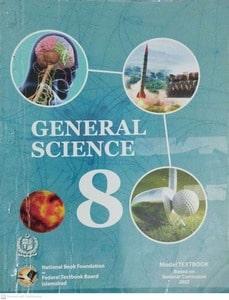
Study chapter-wise, SLO-based Class 8 General Science notes prepared according to the latest Federal Board syllabus and NBF textbook. Access solved exercises, MCQs, short questions, long questions, definitions, diagrams, and exam-focused preparation material.
The 8th Class General Science Notes FBISE page provides complete chapter-wise study material for Federal Board Grade 8 students following the 2026-2027 National Book Foundation (NBF) curriculum. Students can access solved textbook exercises, conceptual MCQs, short-answer questions, descriptive long questions, and scientific diagrams covering biology, chemistry, physics, technology, and space science. The notes strictly follow SLO-based learning and the Single National Curriculum (SNC) to help learners achieve high marks in school assessments and board examinations.
Select any chapter to read online or download the PDF notes for exam preparation.
Explore ecosystems, biotic and abiotic factors, food chains, food webs, ecological pyramids, symbiotic relationships, energy flow, and the impact of human activities on natural environmental balance.
Examine the central and peripheral nervous systems, structure and functions of neurons, brain, spinal cord, reflex arcs, sensory organs, and nervous system disorders.
Learn about the mechanisms of mitosis and meiosis, transmission of hereditary traits from parents to offspring, DNA, genes, chromosomes, and continuous and discontinuous variations.
Understand genetic modification, cloning, recombinant DNA technology, fermentation, and applications of biotechnology in medicine, agriculture, food production, and environmental management.
Investigate atomic structure, atomic number, mass number, isotopes, periods, groups, periodic trends, and properties of metals, non-metals, and metalloids in the modern periodic table.
Study types of chemical reactions, balancing chemical equations, law of conservation of mass, ionic bonding, covalent bonding, and energy changes in chemical processes.
Analyze properties, indicators, pH scale, neutralization reactions, preparation and practical uses of acids, bases, and salts in daily life and industrial processes.
Explore forces, pressure in liquids and gases, Pascal's principle, hydraulic systems, atmospheric pressure, Archimedes' principle, and practical engineering applications.
Understand laws of reflection and refraction, plane and curved mirrors, lenses, image formation, optical instruments, and vision defects with ray diagrams.
Examine electric current, voltage, resistance, Ohm's law, series and parallel circuits, magnetic effects of currents, electromagnets, and electromagnetic induction.
Discover everyday technology applications, simple machines, medical imaging tools, communication devices, safety equipment, and domestic technological innovations.
Explore galaxies, stars, life cycle of stars, solar system, telescopes, satellites, space exploration missions, and modern theories about the origin and expansion of the universe.
The 8th Class General Science Notes FBISE 2026-2027 are structured educational resources designed specifically for Grade 8 students under the Federal Board of Intermediate and Secondary Education. Aligned with the Single National Curriculum (SNC) and the latest National Book Foundation (NBF) textbook, these notes cover foundational concepts across biological, chemical, physical, and earth sciences.
Science education under the Federal Board has transformed from rote memorization to Student Learning Outcomes (SLOs). Modern assessments evaluate analytical thinking, experimental reasoning, scientific inquiry, problem-solving skills, and real-world applications. These notes provide focused learning material that meets every SLO requirement.
Each chapter is structured into organized sections covering comprehensive chapter summaries, core definitions, solved textbook exercises, objective MCQs with answers, conceptual short questions, and well-explained long answers with scientific diagrams. This modular format allows students to study steadily and prepare effectively for school tests and board examinations.
These educational notes are crafted to simplify the Grade 8 General Science curriculum prescribed by FBISE. They present complex scientific principles, biological processes, chemical reactions, physical laws, and technological developments in simple, accessible language while maintaining complete academic rigor.
These notes are designed to serve as an indispensable study companion alongside the official National Book Foundation (NBF) textbook. Students should first read the textbook chapters and then use these solved notes to solidify conceptual understanding, check exercise responses, and revise critical points.
Depending on the chapter, the notes provide:
Students can use the chapter-wise material to access the following learning resources:
Complete solutions and step-by-step answers for all textbook review exercises.
Conceptual and factual multiple-choice questions covering all textbook topics and SLOs.
Clear, focused short answers ideal for 2-mark and 3-mark exam questions.
Comprehensive, well-structured long responses with clear headings, diagrams, and examples.
Key scientific terms, chemical laws, biological processes, and physical principles essential for exam revision.
Clear anatomical diagrams, circuit schematics, ray diagrams, and periodic table charts.
Analytical and scenario-based queries designed to test deep conceptual understanding.
Convenient options to read online or download chapter-wise PDF notes for offline study.
The content is fully aligned with the Single National Curriculum (SNC) framework and the Student Learning Outcomes (SLOs) prescribed by the Federal Board for Grade 8 General Science. The updated syllabus reflects a modern, integrated approach to science education, bridging theoretical concepts with experimental observation and technological applications. Topics covering human biology, heredity, biotechnology, periodic table, chemical reactions, force and pressure, optics, electromagnetism, and astronomy prepare students thoroughly for advanced secondary studies in physics, chemistry, and biology.
Follow this simple preparation method to get better results in General Science.
Begin by thoroughly reading the assigned unit in the NBF Class 8 General Science textbook to understand foundational principles, diagrams, and activities.
Review fundamental scientific terminology, formulas, and scientific laws using the chapter summary points.
Practice the objective-type MCQs for each chapter to test your factual accuracy and understanding of scientific concepts.
Learn textbook short questions and additional SLO-based conceptual questions with focused, point-wise answers.
Master descriptive questions by memorizing headings, bullet points, chemical equations, and experimental proofs.
Draw and label anatomical organs, ray diagrams, electrical circuits, and balance chemical equations to secure maximum marks.
Review the concise revision points and downloadable PDF notes prior to periodic tests, term exams, and annual assessments.
Use these resources to complete your General Science preparation and other subjects.
Yes, these notes are strictly structured according to the latest Federal Board Class 8 General Science syllabus and Single National Curriculum (SNC) for the 2026-2027 academic session.
Yes. The content focuses directly on Student Learning Outcomes (SLOs), emphasizing conceptual understanding, inquiry-based reasoning, scientific application, and analytical problem-solving rather than rote memorization.
Yes. The chapter breakdown, conceptual topics, diagrams, and solved exercise questions closely correspond to the National Book Foundation (NBF) textbook prescribed for Federal Board Grade 8.
Yes. Every chapter provides complete, step-by-step solutions for textbook review questions, fill-in-the-blanks, conceptual short questions, and descriptive long questions.
Yes. Each chapter offers comprehensive multiple-choice questions with verified answer keys and conceptual rationale to aid objective exam preparation.
Yes. High-quality downloadable PDF notes are made accessible on individual chapter pages for offline studying, printing, and revision.
Yes. Students can easily download specific chapters individually without having to download a large multi-chapter document.
Absolutely. The notes cover short questions, comprehensive long answers, diagram practice, and SLO-based scenarios that frequently appear in FBISE mid-terms and annual assessments.
Yes. All chapter notes, solved exercises, MCQs, and guides are fully readable online on mobile devices, tablets, and desktop computers through StudyPlusPlus.
The material simplifies complex scientific ideas into clear, straightforward language with bulleted explanations, structured headings, and visual illustrations, helping students build strong foundations at their own pace.
Yes. The material is completely aligned with the Single National Curriculum (SNC) standards established by the Ministry of Federal Education and Professional Training.
The notes provide comprehensive coverage of syllabus objectives, but students are always advised to read their official NBF textbook and practice lab-related activities alongside these notes.
No. Class 8 is Middle Stage (Grade 8), whereas SSC-I (Secondary School Certificate Part 1) refers to Class 9 (Matric Part 1) where science splits into separate disciplines of Physics, Chemistry, and Biology/Computer Science.
Punjab Board students can benefit from the shared core scientific topics like ecology, nervous system, biotechnology, chemical reactions, acids and bases, and electricity, but they should verify against their specific Punjab Curriculum and Textbook Board (PCTB) syllabus.