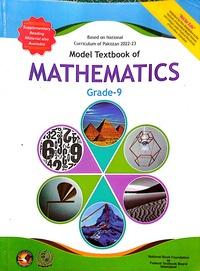
Chapter-wise notes, solved exercises, MCQs, short questions and long questions for the NBF Mathematics book, aligned with the National Curriculum and SLO-based preparation.
Federal BoardClass 9MathematicsEnglish MediumSession 2026-2027SLO BasedSNC AlignedNBF Textbook
Quick Answer
StudyPlusPlus offers FBISE Class 9 Mathematics resources for session 2026-2027, based on the National Book Foundation (NBF) textbook. The page covers all 11 chapters, with chapter-wise notes, solved exercises, and short and long question preparation. Students can practise straight MCQs and scenario/stimulus/situation-based MCQs for the objective paper. All material follows the National Curriculum and SLO-based preparation for Federal Board annual examinations.
Chapter-Wise Mathematics Notes
Select any chapter to read online or download the PDF solved exercises and MCQs for exam preparation.
Chapter 1
Real Numbers
Study real numbers, their properties, decimal representation, and radical expressions. Understand complex numbers, basic operations, and conjugate properties for algebraic calculations.
Learn the concept of scientific notation, common and natural logarithms, laws of logarithms, and their applications in solving complex numerical calculations.
Construct triangles, parallelograms, circles, tangents, and inscribed/escribed figures using a compass and straightedge. Practice step-by-step constructions.
Understand data collection, frequency distributions, cumulative frequency, measures of central tendency (mean, median, mode), and graphical representation of data.
Class 9 Mathematics covers algebra, geometry, trigonometry and statistics. It begins with real numbers, logarithms, sets, factorization and linear equations, and then moves to trigonometry, coordinate geometry, polygons, constructions and basic statistics. In FBISE examinations, Mathematics rewards steady practice more than last-minute reading. Students need to know formulas, follow the steps of a solution, and apply concepts to real-life problems. This page brings all 11 chapters of the NBF Mathematics book into one place, so students can move from the textbook PDF to notes and practice easily.
The chapter-wise notes explain definitions, formulas, rules and worked examples in simple English. Solved textbook exercises show how problems are set out step by step, which helps in both short and long questions. The notes follow the SLO-based approach of the National Curriculum, which separates outcomes assessed in the annual examination from those taught as regular classroom practice. This helps students spend more revision time on the outcomes that are examined. Diagrams such as Venn diagrams, graphs, histograms and geometric constructions are part of the relevant chapters.
For the objective paper, students can practise straight MCQs and scenario, stimulus and situation-based MCQs. These test whether a student can apply a concept to a practical situation. Short and long question practice prepares students for the subjective paper. Together with chapter-wise revision, these resources support FBISE Mathematics preparation from the first chapter to final revision.
Paper Pattern
The FBISE Class 9 Mathematics paper has an objective portion and a subjective portion. The two portions together carry 75 marks.
Objective portion (36 marks): This part has 48 MCQs, and each MCQ carries 0.75 marks. Of these, 32 are straight/flat MCQs, which test direct knowledge of definitions, formulas and rules. The other 16 are scenario/stimulus/situation-based MCQs, which give a short situation, statement or data and ask students to apply a concept to answer.
Subjective portion (39 marks): This part has two sections.
Section B (SRQs): 7 short response questions of 3 marks each, which makes 21 marks.
Section C (ERQs): 3 extended response questions of 6 marks each, which makes 18 marks.
SLO-based assessment: Each Student Learning Outcome (SLO) is marked as formative or summative. Summative SLOs are assessed in the annual examination. Formative SLOs are part of regular classroom teaching and are not asked in the annual examination. Each SLO also has a cognitive level: Knowledge (K), Understanding (U) or Application (A). Students should therefore practise recalling formulas, explaining steps and solving real-life problems.
What Is Included in the Notes?
Students can use the chapter-wise material to access the following learning resources:
✓
Solved Exercises
Every single question from the National Book Foundation (NBF) textbook exercises is fully solved with clear, step-by-step mathematical steps.
A
MCQs
Multiple-choice questions with explained answers to help students secure full marks in the objective section of the exam paper.
Q
SRQ Preparation
Short questions focused on the direct application of algebraic, trigonometric, and statistical formulas.
L
ERQ Preparation
Detailed answers for complex problems, lengthy algebraic simplifications, and mathematical proofs.
D
Definitions
Precise, board-standard definitions of mathematical terms, axioms, and properties with relevant examples.
◎
Diagrams
Clear graphical illustrations for coordinate geometry plots, trigonometric bearings, and geometric constructions.
★
SLO-based Questions
Conceptual problems and unseen application questions designed specifically for the Federal Board SLO model.
↓
PDF Download
Direct links to download chapter-wise notes for offline reading and convenient revision before exams.
SNC and National Curriculum Alignment
These 9th Class Mathematics Notes are fully aligned with the Single National Curriculum (SNC) guidelines of Pakistan and the Student Learning Outcomes (SLO) model of the Federal Board (FBISE). The syllabus focuses on conceptual depth, mathematical reasoning, and logical progression, preparing students for higher studies in STEM fields. Our notes support this educational reform by emphasizing core concepts and logical proofs rather than rote learning.
How to Prepare Class 9 Mathematics from These Notes
Follow this simple preparation method to get better results in Mathematics.
1
Revise one chapter at a time, noting key formulas, rules and definitions.
2
Read the chapter notes, then solve the textbook exercises without looking at the solutions.
3
Focus first on SLOs marked for the annual examination.
4
Practise straight MCQs after each chapter, then move to scenario/stimulus/situation-based MCQs.
5
Practise 3-mark short questions and 6-mark long questions with every step written.
6
In the final weeks, revise formulas, constructions and graphs, and attempt timed mixed-chapter MCQs.
Related Resources
Use these resources to complete your Mathematics preparation and other subjects.
What is the FBISE paper pattern for Class 9 Mathematics?
The objective portion is 36 marks (48 MCQs of 0.75 marks each). The subjective portion is 39 marks (7 SRQs of 3 marks and 3 ERQs of 6 marks).
Are scenario-based MCQs important for annual examinations?
Yes. 16 of the 48 MCQs, which is 12 marks, are scenario/stimulus/situation-based, so regular practice is important.
How should students prepare for FBISE objective papers?
Revise formulas and definitions chapter by chapter. Practise straight MCQs first, then scenario-based MCQs, and finish with timed mixed-chapter practice.
Are these notes useful for board examinations?
Yes. They follow the NBF Class 9 Mathematics book and the National Curriculum, so they suit FBISE annual examination preparation.
Are all SLOs asked in the annual examination?
No. SLOs marked summative are asked in the annual examination. SLOs marked formative are taught in class but are not asked in the annual examination.
Which chapters are covered in Class 9 Mathematics?
There are 11 chapters: Real Numbers, Logarithms, Sets and Relations, Factorization and Algebraic Manipulation, Linear Equations and Inequalities, Trigonometry and Bearing, Coordinate Geometry, Geometry of Straight Lines, Geometry and Polygons, Practical Geometry, and Basic Statistics.
Educational Notice: This content is provided for educational support only. It is not for sale, redistribution, or commercial use. StudyPlusPlus is not claiming official ownership of any government textbook material.