Chapter 1
Notes + Exercise LinkPlant Systems
Master root and shoot systems, leaf anatomy, transport mechanisms, transpiration, photosynthesis, mineral requirements, and respiration in plants.
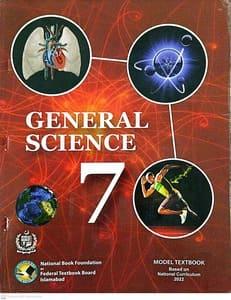
Complete chapter-wise solved notes, MCQs, short & long questions, and SLO-based exercises for Class 7 General Science according to the 2026-2027 NBF textbook.
Looking for complete Class 7 General Science notes for Federal Board (FBISE)? StudyPlusPlus provides comprehensive, SLO-aligned chapter-wise notes based on the latest National Book Foundation (NBF) textbook for the 2026-2027 academic session. Access solved textbook exercises, conceptual MCQs, short questions, detailed long questions, labeled diagrams, and free PDF downloads for all 12 chapters.
Select any chapter below to read online or download the free PDF solved exercises for exam preparation.
Master root and shoot systems, leaf anatomy, transport mechanisms, transpiration, photosynthesis, mineral requirements, and respiration in plants.
Understand human gas exchange, breathing mechanisms, aerobic vs anaerobic respiration, heart structure, blood vessels, and blood circulation.
Explore innate and adaptive immunity, antibody formation, passive immunity, ways to boost immunity, and infectious diseases like COVID-19, Dengue, Hepatitis-B, and Typhoid.
Differentiate physical and chemical changes, analyze states of matter, thermal conductivity, combustion, rusting of iron, and tarnishing of silver.
Study atomic structure, protons, neutrons, electrons, atomic number, mass number, electron shell distribution, and the Modern Periodic Table.
Learn valency concepts, cation and anion formation, writing chemical formulas, ionic bonding, and covalent bonding for Grade 7 Science.
Explore solutions, water as a universal solvent, dilute and concentrated solutions, solubility, and factors affecting dissolution (temperature, stirring, grinding).
Analyze speed calculation, distance-time graphs, contact vs non-contact forces, Newton's third law action-reaction pairs, and rocket propulsion principles.
Examine mechanical and electromagnetic waves, transverse and longitudinal waves, wave frequency and amplitude relations, sound properties, pitch, loudness, and echoes.
Understand temperature scales (Celsius, Fahrenheit, Kelvin), temperature conversion formulas, thermal expansion applications, heat transfer methods, and thermal insulation.
Discover water conservation, drip and sprinkler irrigation models, food preservation methods (canning, freezing, pickling, drying), stethoscopes, and sanitizers.
Study gravitational forces in orbital motion, mass vs weight, lunar tides, Earth's axis tilt, seasonal changes, constellations, and annual orbital relationships.
General Science for Class 7 in Federal Board (FBISE) forms a fundamental bridge connecting basic elementary science concepts to advanced high school biology, chemistry, physics, and earth sciences. Following the Single National Curriculum (SNC) and the National Book Foundation (NBF) textbook for the 2026-2027 academic session, this course encourages analytical thinking, conceptual understanding, and practical scientific application.
Our Class 7 General Science notes are specifically written to meet the Student Learning Outcomes (SLO) assessment pattern adopted by FBISE. Traditional rote learning is replaced by conceptual clarity, detailed scientific reasoning, step-by-step mathematical calculations for speed and temperature, and accurately labeled diagrams.
Whether you are preparing for school monthly assessments, term exams, send-ups, or Federal Board annual exams, these comprehensive chapter-wise notes ensure complete coverage of solved exercises, multiple-choice questions (MCQs), short-answer questions, and structured long-answer questions.
These notes serve as an all-in-one academic resource designed by experienced science educators for Federal Board students.
Each chapter is systematically organized to include clear topic explanations, key definitions, solved textbook exercises, and supplemental SLO-based practice questions.
By using these notes alongside your official NBF textbook, students can easily review difficult scientific concepts and master exam-style questions:
Students can access the following structured learning materials for every chapter of Class 7 General Science:
Complete and accurate answers to all NBF textbook exercise questions for all 12 chapters.
SLO-aligned conceptual and knowledge-based multiple-choice questions with verified answer keys.
Concise answers focused on definitions, scientific reasons, comparisons, and core concepts.
Comprehensive, multi-part answers organized with clear headings, bullet points, and steps.
Precise scientific definitions of key terminology across biology, chemistry, physics, and space.
Neat, labeled scientific diagrams illustrating plant organs, human systems, atoms, waves, and circuits.
Application and analytical practice questions designed for FBISE's modern testing standards.
Free downloadable PDF files for each of the 12 chapters for convenient offline studying.
These Class 7 General Science notes are 100% aligned with the Single National Curriculum (SNC) and National Curriculum guidelines of Pakistan. They strictly adhere to the Student Learning Outcomes (SLO) framework mandated by the Federal Board of Intermediate and Secondary Education (FBISE) for the 2026-2027 academic session using the official National Book Foundation (NBF) textbook.
Follow this step-by-step strategy to achieve top scores in your General Science examinations:
Thoroughly read the NBF textbook chapter to gain a general understanding of topics and diagrams.
Review the summary points and scientific definitions in these notes to reinforce fundamental principles.
Practice conceptual MCQs to build quick recall and evaluate objective section readiness.
Master short-answer questions to learn how to state scientific facts and reasons concisely.
Study structured long questions under appropriate headings to construct detailed exam answers.
Draw and label key diagrams (e.g., plant transport, respiratory system, atomic structure, and heat transfer).
Utilize chapter-wise PDF downloads for quick revision before school tests and final examinations.
Explore these helpful study resources for Class 7 and other FBISE subjects:
Yes, these solved notes are completely updated for the 2026-2027 academic session based on the latest National Book Foundation (NBF) textbook for Federal Board (FBISE).
Yes, all chapter exercises, MCQs, short questions, and long questions strictly follow the Student Learning Outcomes (SLO) framework required by FBISE.
Yes, all 12 chapters—ranging from Plant Systems and Human Body Systems to Waves, Heat, Technology, and Earth & Space—are comprehensively covered and solved.
Yes, full solutions for textbook exercises including MCQs, fill-in-the-blanks, short-answer questions, and descriptive long questions are provided.
Yes, chapter-wise PDF download links are available on each chapter page so you can read offline at any time for free.
Yes, essential labeled scientific diagrams such as leaf cross-sections, human heart structure, wave properties, and temperature scale comparisons are included.
To get full marks, write structured answers using proper headings, draw labeled diagrams where applicable, and state exact scientific formulas or terms.
Yes, all notes, textbook guides, and learning resources on StudyPlusPlus are 100% free for students and teachers.
Yes, these notes comply strictly with the National Curriculum guidelines and SNC standards approved by the Government of Pakistan.
While tailored to the NBF textbook for FBISE, fundamental topics like photosynthesis, respiration, atomic structure, solutions, waves, and heat are common to Punjab Board and other regional boards.
Physical changes involve alterations in state or appearance without forming new substances (e.g. melting ice), whereas chemical changes produce new substances with different chemical properties (e.g. rusting iron).
Temperature conversions between Celsius, Fahrenheit, and Kelvin use specific formulas such as K = C + 273.15 and F = (C × 9/5) + 32, which are fully explained in Chapter 10 notes.