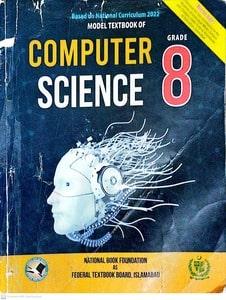
Study chapter-wise, SLO-based Class 8 Computer Science notes prepared according to the latest Federal Board syllabus and NBF textbook. Access solved exercises, MCQs, short questions, long questions, definitions, flowcharts, programming tasks, and exam-focused preparation material.
Federal BoardGrade 8Computer ScienceEnglish MediumSession 2026-2027SNC AlignedNBF TextbookChapter-Wise Notes
Quick Answer
The 8th Class Computer Science Notes FBISE page provides complete chapter-wise study material for Federal Board Grade 8 students following the 2026-2027 National Book Foundation (NBF) curriculum. Students can access solved textbook exercises, conceptual MCQs, short and long questions, practical digital skills, algorithmic flowcharts, and programming guides. The notes strictly adhere to SLO-based learning and the Single National Curriculum (SNC) to help learners excel in school assessments and board-level evaluations.
Chapter-Wise Computer Science Notes
Select any chapter to read online or download the PDF notes for exam preparation.
Chapter 1
ICT Fundamentals
Explore the basics of Information and Communication Technology (ICT), modern computer hardware, software systems, and data processing. Understand input, output, storage devices, and real-world ICT applications.
Master essential computer productivity tools including word processing, spreadsheets, presentation software, and effective internet search strategies to boost academic and personal digital proficiency.
Build practical coding capabilities through fundamental programming concepts like variables, data types, conditional statements, loops, and structured coding in modern beginner-friendly languages.
Understand ethical digital behavior, online safety, privacy protection, cyber threats, cyberbullying awareness, intellectual property rights, and responsible social media usage.
Discover how to transform digital skills into creative ventures, covering freelancing fundamentals, basic business models, digital marketing, innovation, and tech startup ideas.
Overview of 8th Class Computer Science Notes FBISE
The 8th Class Computer Science Notes FBISE 2026-2027 are structured learning resources designed for Grade 8 students under the Federal Board of Intermediate and Secondary Education. Aligned with the Single National Curriculum (SNC) and the latest National Book Foundation (NBF) textbook, these notes cover core theoretical concepts, computational thinking principles, and real-world technical skills.
Modern computer science education in Pakistan has evolved beyond mere factual recall to focus heavily on Student Learning Outcomes (SLOs). Federal Board assessments challenge students on problem decomposition, algorithm planning, programming logic, digital safety, and technological innovation. These notes provide direct support for both conceptual clarity and practical application.
Each chapter is organized into modular study blocks including core definitions, textbook question-and-answer solutions, objective-type multiple-choice questions (MCQs), structured short questions, detailed explanations, and review diagrams. This systematic layout empowers students to master each unit progressively throughout the academic term.
What Are These Computer Science Notes?
These educational notes are designed to simplify the Grade 8 Computer Science syllabus prescribed by FBISE. They present complex computational concepts, syntax, and theoretical definitions in lucid, student-centric language without compromising academic precision.
Rather than substituting the prescribed NBF textbook, these notes serve as an indispensable study companion. Students are encouraged to read textbook chapters first, using these notes to reinforce understanding, verify exercise answers, and revise thoroughly for school exams.
Depending on the unit content, the chapter-wise notes provide:
Chapter summaries and core takeaways
Essential ICT and computing terminology
Step-by-step algorithm design and flowcharts
Solved textbook exercises and conceptual questions
Multiple-choice questions (MCQs) with explanations
Concise short-answer questions
Comprehensive long-answer questions
Hands-on programming logic and syntax examples
Digital safety, cyber ethics, and cybersecurity principles
Practical digital productivity tutorials
SLO-based analytical and practice problems
Quick exam revision pointers
All chapters strictly adhere to the official NBF curriculum sequence for effortless lesson coordination.
What Is Included in the Notes?
Students can use the chapter-wise material to access the following learning resources:
✓
Solved Exercises
Complete solutions and step-by-step answers for all textbook review exercises.
A
MCQs
Conceptual and factual multiple-choice questions covering all textbook topics and SLOs.
Q
Short Questions
Clear, focused short answers ideal for 2-mark and 3-mark exam questions.
L
Long Questions
Comprehensive, well-structured long responses with clear headings, diagrams, and examples.
D
Definitions
Key computing terms, abbreviations, and definitions essential for exam revision.
◎
Diagrams
Clear flowcharts, system diagrams, and software interface illustrations.
★
SLO-based Questions
Analytical and scenario-based queries designed to test deep conceptual understanding.
↓
PDF Download
Convenient options to read online or download chapter-wise PDF notes for offline study.
SNC and National Curriculum Alignment
The content is fully aligned with the Single National Curriculum (SNC) framework and the Student Learning Outcomes (SLOs) prescribed by the Federal Board for Grade 8 Computer Science. The updated syllabus reflects modern 21st-century digital competencies, transitioning students from passive computer users to analytical problem-solvers. Units focusing on algorithmic thinking, introductory programming, digital safety, cyber ethics, and digital entrepreneurship prepare young learners for future STEM pursuits and real-world technological challenges.
How to Prepare Class 8 Computer Science from These Notes
Follow this simple preparation method to get better results in Computer Science.
1
Read the textbook chapter first
Begin by thoroughly reading the relevant unit in the NBF Class 8 Computer Science textbook to understand the fundamental concepts and illustrations.
2
Revise key concepts and definitions
Study core computing terminology, hardware/software functions, and important theoretical definitions using the notes summary points.
3
Solve MCQs for conceptual clarity
Practice the objective-type MCQs at the end of each unit to evaluate your grasp on factual details and technical terms.
4
Prepare short questions thoroughly
Learn textbook short-answer questions and supplementary conceptual questions with precise, structured answers.
5
Practice long questions and code logic
Master detailed topics, programming syntax, code structures, and descriptive answers with clear headings and bullet points.
6
Practice flowcharts and system diagrams
Draw flowchart symbols and tracing algorithms on paper to develop confident visual problem-solving abilities.
7
Revise before tests and term exams
Review the summary sheets and downloadable PDF notes right before periodic assessments and final school examinations.
Related Resources
Use these resources to complete your Computer Science preparation and other subjects.
Are these Class 8 Computer Science notes based on the latest FBISE syllabus?
Yes, these notes are strictly structured according to the latest Federal Board Class 8 Computer Science syllabus and Single National Curriculum (SNC) for the 2026-2027 academic session.
Are these Computer Science notes SLO based?
Yes. The content focuses directly on Student Learning Outcomes (SLOs), emphasizing conceptual understanding, practical problem-solving, algorithm construction, and digital literacy rather than rote memorization.
Do these notes follow the NBF Computer Science textbook?
Yes. The chapter breakdown, conceptual topics, and solved exercise questions closely correspond to the National Book Foundation (NBF) textbook prescribed for Federal Board Grade 8.
Are solved textbook exercise questions included?
Yes. Every chapter provides complete, step-by-step solutions for textbook review questions, fill-in-the-blanks, true/false exercises, and activity tasks.
Do the notes include solved MCQs with explanations?
Yes. Each chapter offers comprehensive multiple-choice questions with verified answer keys and conceptual rationale to aid objective exam preparation.
Can I download the Class 8 Computer Science notes in PDF format?
Yes. High-quality downloadable PDF notes are made accessible on individual chapter pages for offline studying, printing, and revision.
Can I download chapter-wise notes separately?
Yes. Students can easily download specific chapters individually without having to download a large multi-chapter document.
Are these notes useful for FBISE annual examinations and school tests?
Absolutely. The notes cover short questions, comprehensive long answers, diagram practice, and SLO-based scenarios that frequently appear in FBISE mid-terms and annual assessments.
Can I read the Computer Science notes online without downloading?
Yes. All chapter notes, solved exercises, MCQs, and guides are fully readable online on mobile devices, tablets, and desktop computers through StudyPlusPlus.
How do these notes help weak or struggling students?
The material simplifies technical jargon into clear, straightforward language with bulleted explanations, visual flowcharts, and worked examples, helping students build strong foundations at their own pace.
Do these notes follow the Single National Curriculum (SNC)?
Yes. The material is completely aligned with the Single National Curriculum (SNC) standards established by the Ministry of Federal Education and Professional Training.
Are these notes sufficient for full exam preparation?
The notes provide comprehensive coverage of syllabus objectives, but students are always advised to read their official NBF textbook and practice past test papers alongside these notes.
Educational Notice: This content is provided for educational support only. It is not for sale, redistribution, or commercial use. StudyPlusPlus is not claiming official ownership of any government textbook material.