Chapter 1
Notes + Exercise LinkReal Numbers
Explore real numbers, rational and irrational numbers, terminating and recurring decimals, representation on the number line, and fundamental properties of real numbers under addition and multiplication.
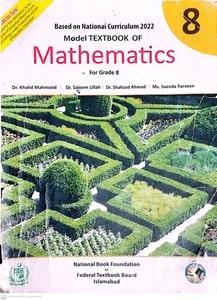
Study chapter-wise, SLO-based Class 8 Mathematics notes prepared according to the latest Federal Board syllabus and NBF textbook. Access solved exercises, MCQs, short questions, long questions, formula sheets, and exam-focused revision material.
The 8th Class Mathematics Notes FBISE page provides complete chapter-wise study material for Federal Board Grade 8 students following the 2026-2027 National Book Foundation (NBF) curriculum. Students can access solved textbook exercises, conceptual MCQs, short-answer questions, detailed step-by-step long questions, and practical geometry guides covering Real Numbers, Algebra, Geometry, Mensuration, and Probability. The notes strictly follow SLO-based learning and the Single National Curriculum (SNC) to help learners achieve top grades in school assessments and board examinations.
Select any chapter to read online or download the PDF notes for exam preparation.
Explore real numbers, rational and irrational numbers, terminating and recurring decimals, representation on the number line, and fundamental properties of real numbers under addition and multiplication.
Master rounding off numbers to required decimal places and significant figures, making reasonable approximations, and estimating multi-step calculations in everyday real-world contexts.
Learn calculating square roots and cube roots of whole numbers, common fractions, and decimal numbers using prime factorization and long division methods, along with real-life application word problems.
Understand percentages, profit and loss calculations, discount, markup, simple interest, partnership ratios, commercial banking terms, and Islamic financial concepts including Zakat and Ushr.
Study set notations, operations on sets including union, intersection, difference, and complement, representation through Venn diagrams, and step-by-step verification of De Morgan's laws.
Explore polynomials, algebraic operations, linear number patterns, arithmetic sequences, nth-term formula derivation, expansion, and factorization of algebraic expressions using standard algebraic identities.
Solve linear equations in one variable, simultaneous linear equations using algebraic elimination and substitution, linear inequalities, and their graphic representations on the Cartesian plane.
Examine geometric transformations including translation, reflection, rotation about a center point, and enlargement (dilation) with scale factors and coordinate mapping on the Cartesian coordinate system.
Understand angle relationships formed by intersecting and parallel lines with transversals, properties of triangles and quadrilaterals, interior and exterior angles of polygons, and circle theorems.
Construct triangles, quadrilaterals, parallelograms, rhombuses, and regular polygons using a straightedge and compasses following step-by-step geometric construction algorithms.
Calculate perimeter and area of composite plane figures, as well as total surface area and volume of 3D geometric solids including cylinders, prisms, pyramids, cones, and spheres.
Collect, organize, and interpret grouped and ungrouped statistical data, construct frequency distribution tables, histograms, frequency polygons, and compute mean, median, and mode.
Grasp fundamental probability concepts, sample spaces, equally likely outcomes, event probabilities, tree diagrams, and calculating experimental versus theoretical probabilities in real-life experiments.
Mathematics for Class 8 under the Federal Board of Intermediate and Secondary Education (FBISE) serves as the vital bridge between elementary arithmetic and high-school mathematics. As students prepare for the rigorous secondary stage (SSC-I Matric Part 1), building a rock-solid foundation in real numbers, algebra, linear equations, geometry, and data handling is essential. The modern Federal Board curriculum is structured to cultivate analytical thinking, spatial visualization, and systematic problem-solving skills rather than mere procedural drill.
In full alignment with the Single National Curriculum (SNC) and the latest National Book Foundation (NBF) textbook, the Class 8 Mathematics syllabus is organized around Student Learning Outcomes (SLOs). Modern board examinations evaluate conceptual comprehension and application capabilities. Questions require learners to apply algebraic equations to word problems, compute commercial percentages and financial zakat/ushr, construct accurate geometric figures with geometrical tools, and calculate perimeters and volumes of composite solids.
StudyPlusPlus provides a comprehensive suite of chapter-wise Class 8 Mathematics notes tailored specifically to meet FBISE standards. Each chapter features lucid concept summaries, step-by-step textbook exercise solutions, verified MCQs with mathematical rationale, focused short questions, and comprehensive long-answer problem sets. Accessible online and through downloadable PDF files, these resources equip students for top academic performance across periodic tests and final board assessments.
These Class 8 Mathematics notes are comprehensive, curriculum-aligned study materials specifically formulated for students studying under the Federal Board of Intermediate and Secondary Education. Created by experienced mathematics subject specialists, they adhere strictly to the official National Book Foundation (NBF) textbook, translating complex algebraic operations, geometrical proofs, and statistical procedures into easy-to-follow, step-by-step methods.
The notes serve as an indispensable learning companion alongside your NBF textbook. Students should begin each topic by studying textbook definitions and solved examples, then use these notes to verify exercise solutions, reinforce formula applications, and master high-frequency examination problem formats.
Depending on the chapter, the notes provide:
Students can use the chapter-wise material to access the following learning resources:
Complete, step-by-step solutions for all textbook review exercises, numerical problems, and algebra questions.
Comprehensive objective multiple-choice questions with verified answer keys to master Section-A of the exam.
Direct, concept-based short questions designed to develop computational accuracy and quick problem-solving skills.
Detailed multi-step problems, algebraic proofs, word problems, and real-world scenario questions.
Clear and mathematically precise definitions of key terms, sets, geometric entities, and statistical concepts.
Accurately constructed geometric figures, coordinate graphs, Venn diagrams, and statistical charts.
High-order thinking questions testing knowledge, understanding, and application as mandated by FBISE.
Convenient chapter-wise downloadable PDF files for offline study, home revision, and printing.
These Class 8 Mathematics notes strictly comply with the Single National Curriculum (SNC) standards and the National Curriculum framework established by the Ministry of Federal Education and Professional Training. Designed exclusively around the prescribed National Book Foundation (NBF) textbook, the content adheres to the modern Student Learning Outcomes (SLO) assessment structure. Instead of encouraging rote learning, the material evaluates students across cognitive domains of knowledge (30%), understanding (50%), and real-world application (20%), equipping Grade 8 learners with strong mathematical competencies for future SSC board exams.
Follow this proven preparation method to master concepts and achieve top marks in Mathematics.
Start by reading the introductory chapter in your NBF textbook to understand fundamental mathematical definitions, symbols, and principles.
Review the solved examples provided in each chapter, noting down formulas and observing step-by-step algebraic manipulations and logical transitions.
Attempt the chapter-wise conceptual MCQs without looking at the answer keys to evaluate your grasp over mathematical properties and mental arithmetic.
Practice solving short questions on paper, paying special attention to writing correct units, formulas, and neat algebraic steps.
Work through descriptive long questions, financial calculations, factorization problems, and mensuration word problems step by step.
Use a sharp pencil, ruler, and compasses to draw accurate practical geometry figures and plot linear equations on graph paper.
Regularly review chapter summary sheets and downloadable PDF notes before periodic tests, term exams, and final school assessments.
Use these resources to complete your Mathematics preparation and explore other Grade 8 subjects.
Yes, these notes are strictly structured according to the latest Federal Board Class 8 Mathematics syllabus and Single National Curriculum (SNC) for the 2026-2027 academic session.
Yes. The content focuses directly on Student Learning Outcomes (SLOs), emphasizing conceptual understanding, problem-solving techniques, algebraic reasoning, and practical applications rather than rote memorization.
Yes. The chapter breakdown, conceptual topics, solved exercises, and geometric constructions closely correspond to the National Book Foundation (NBF) textbook prescribed for Federal Board Grade 8.
Yes. Every chapter provides complete, step-by-step solutions for all textbook review exercises, numerical problems, and practical questions.
Yes. Each chapter offers comprehensive multiple-choice questions with verified answer keys and step-by-step conceptual explanations to aid objective exam preparation.
Yes. High-quality downloadable PDF notes are made accessible on individual chapter pages for offline studying, printing, and revision.
Yes. Students can easily download specific chapters individually without having to download a large multi-chapter document.
Absolutely. The notes cover short questions, comprehensive long answers, geometry practice, and SLO-based numerical scenarios that frequently appear in FBISE assessments.
Yes. All chapter notes, solved exercises, MCQs, and formula sheets are fully readable online on mobile devices, tablets, and desktop computers through StudyPlusPlus.
The material simplifies difficult algebraic, geometric, and numerical concepts into clear, step-by-step explanations with worked examples and formula summaries, helping students build confidence at their own pace.
Yes. The material is completely aligned with the Single National Curriculum (SNC) standards established by the Ministry of Federal Education and Professional Training.
The notes provide complete, rigorous coverage of all syllabus learning outcomes. When studied diligently alongside the official NBF textbook, students can prepare thoroughly for tests and examinations without needing extra tuition.
No. Class 8 is Middle Stage (Grade 8), whereas SSC-I (Secondary School Certificate Part 1) refers to Class 9 (Matric Part 1).
Punjab Board students can benefit from shared mathematical concepts like real numbers, algebra, geometry, and mensuration, but they should cross-check against their specific Punjab Curriculum and Textbook Board (PCTB) syllabus.